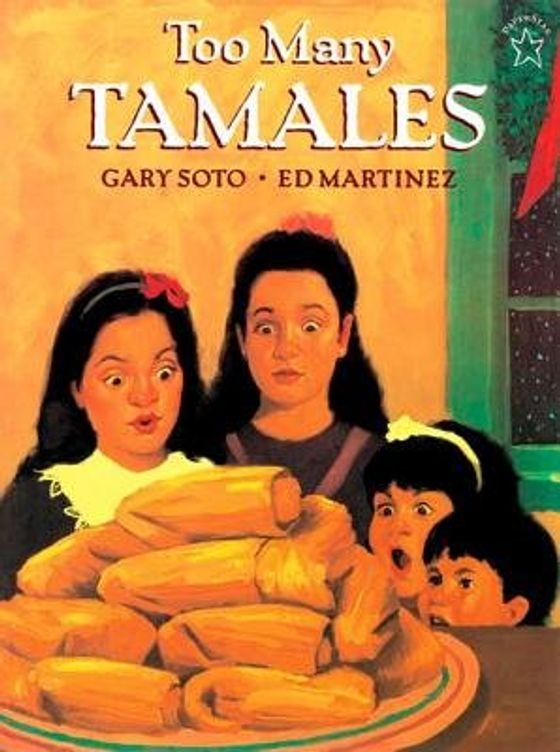
Too Many Tamales
by Gary Soto
The ring is missing. It might be in one of the tamales. They eat them all.
For you if
your child deserves to see a Mexican American family Christmas that is as joyful and chaotic and real as their own
⚡ Choose Your Route ⚡
Not sold directly on this site. Support indie bookstores with a new copy, or go sustainable with a used one.
Buy New on Bookshop.orgSupports independent bookstores
— OR —
Find Used on Better World BooksSecondhand & sustainable
$19 MSRP
Reference price shown. Other editions may be available.
Maria is helping her mother make tamales for Christmas when she tries on her mother's diamond ring — and later realizes it's gone. Convinced the ring is inside one of the tamales, she and her cousins eat every single one trying to find it. Soto writes with the warmth and specificity of someone who grew up in this kitchen, at this table, with these cousins. The holiday chaos, the tamale-making as ritual, the family that laughs at the disaster together. The picture book that most completely captures the specific joy of a Latin American family holiday — not as cultural display but as lived warmth.
Where This Book Lives
- Setting
- Mexico • Latin America
- Voice
- Written by a Mexican author
Related Viewing
Shares a topic, theme, or setting with this book in the catalog.
Like Water for Chocolate(1992)
dir. Alfonso Arau
Forbidden love, served through food.
In early-1900s Mexico, Tita is forbidden by family tradition from marrying the man she loves, so she pours her longing into the food she cooks — food that carries her emotions, sometimes literally, into everyone who eats it. Adapted from Laura Esquivel's novel.
Why it’s here: Punk in making a kitchen the site of rebellion — Tita's cooking becomes the one language her mother can't control or silence. Pedagogical in showing how inherited "duty" polices women's desire generation after generation, and what it costs to break that chain.
Pedro Páramo(2024)
dir. Rodrigo Prieto
A ghost town where the dead won't stop talking.
A man travels to his late mother's hometown to find the father he never knew, only to discover Comala is a ghost town in the most literal sense — populated by the dead, still narrating the tyranny of the cacique who once ruled it. Adapted from Juan Rulfo's novel.
Why it’s here: Punk in blurring the line between the living and the dead until power and guilt outlast the man who held them — Pedro Páramo's tyranny haunts Comala long after his death. Pedagogical in showing how one man's greed can hollow out an entire town's future.
Same pattern, different era
Different time, different place. The same thing keeps happening.