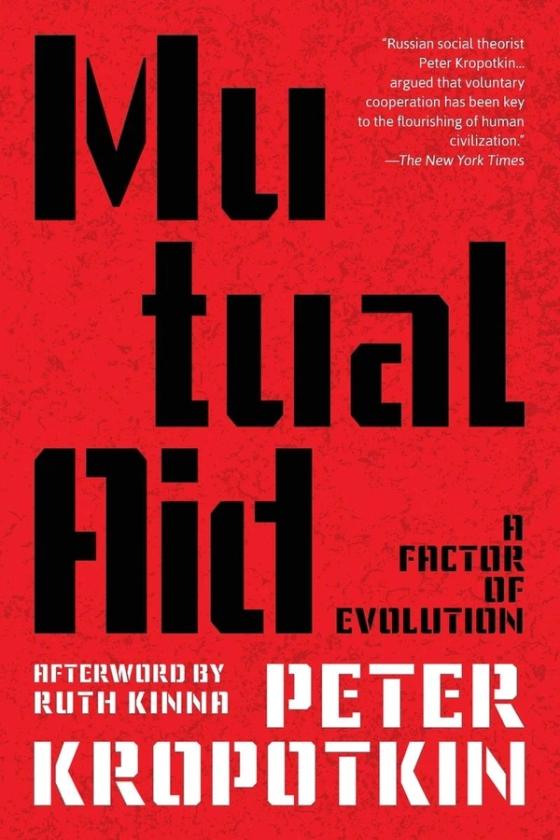
Mutual Aid: A Factor of Evolution
by Peter Kropotkin
Darwin was hijacked. Cooperation beats competition. Here's the proof.
For you if
you want to understand why cooperation is not naive idealism but the most well-documented survival strategy in the history of life on earth
⚡ Choose Your Route ⚡
Not sold directly on this site. Support indie bookstores with a new copy, or go sustainable with a used one.
Buy New on Bookshop.orgSupports independent bookstores
— OR —
Find Used on Better World BooksSecondhand & sustainable
$13 MSRP
Reference price shown. Other editions may be available.
Darwin's theory of evolution was hijacked almost immediately by Social Darwinists who used it to argue that competition, hierarchy, and the strong crushing the weak were natural law — and therefore that capitalism was simply biology. Kropotkin spent years in Siberia watching animals survive brutal conditions and came back with a different answer: cooperation, not competition, is the dominant survival strategy across nature and human history. Mutual Aid is his evidence — from ants to medieval guilds to peasant communes — that the capacity for solidarity is not naive idealism but the most basic fact of how living things survive. His biological observations have since been validated by evolutionary biologists including Stephen Jay Gould. The most subversive scientific argument ever made against capitalism's foundational myth and the intellectual backbone of everything the Make Something Better arc is building toward. Goldman refused the state. Kropotkin explained why cooperation is what we return to when the state gets out of the way.
Where This Book Lives
- Topics
- social darwinism
Related Viewing
Shares a topic, theme, or setting with this book in the catalog.
Worlds of Ursula K. Le Guin(2018)
dir. Arwen Curry
Le Guin explains her own ideas, in her own words.
A decade-in-the-making portrait of Ursula K. Le Guin, made with her direct participation, tracing her life and the ideas — anarchism, utopia and its opposite, gender — running through Earthsea, The Left Hand of Darkness, and The Dispossessed.
Why it’s here: Le Guin explains her own anarchist and utopian thinking here in her own words, not through a scholar's paraphrase — about as close as film gets to the primary source behind The Dispossessed. Punk in that she spent decades on the margins of 'respectable' literature by choice, refusing to soften the politics to fit in; pedagogical in that watching her reason through an idea is a different kind of teaching than reading the novel it produced.
Same pattern, different era
Different time, different place. The same thing keeps happening.
For the family bookshelf
Same idea, written for a younger reader. Good for reading together.